


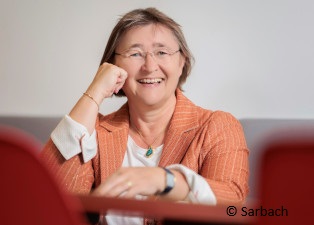
01.04.2026 - Distinguished Lecture Series: Tanja Schultz (University of Bremen)
We are pleased to announce our upcoming Distinguished Lecture Series talk by Tanja Schultz (University of Bremen)! The talk will take place on Wednesday, April 1, 9:45 - 11:15 CET. in room UN32.101.
Tanja Schultz received her Diploma and Ph.D. degrees in informatics from the University of Karlsruhe, Germany. She spent several years as a Researcher and an Adjunct Research Professor at Carnegie Mellon University, Pittsburgh, PA, USA. Over the course of two decades, she has built up the Cognitive Systems Laboratory, where she and her team combine machine learning methods with innovations in biosignal processing to create biosignal-adaptive cognitive systems. Since 2015, Tanja Schultz is a Professor of Cognitive Systems at the University of Bremen, Germany. She is a fellow of ISCA, in 2016; EASA, in 2017; IEEE, in 2020; AAIA, in 2021; ELLIS, in 2024; and VDE ITG, in 2025. She received several awards for her work. Currently, she leads the university’s high-profile area ‘‘Minds, Media, Machines,’’ is a speaker of the DFG Research Unit “Lifespan AI”, and a co-speaker of two research training groups. Recently, she established the international Master’s Program “Artificial Intelligence and Intelligent Systems.”
Title: When AI Listens to Humans: Biosignal-adaptive Speech Communication
When AI Listens to Humans: Biosignal-adaptive Speech Communication
Modern digital devices are increasingly equipped with sensors capable of capturing a wide range of biosignals - data streams resulting from activities of the heart, eyes, muscles, and the brain - that provide real-time insights into human behavior and, when interpreted in context, also into human needs. In the field of speech communication, hearables have emerged as a particularly relevant technology across the lifespan. While younger users commonly wear them as headphones connected to smartphones for media consuption, noise fitering, and hands-free communication, older adults rely on hearing aids to support auditory perception. These ear-centered digital devices offer great potential as platforms for human-centred AI, especially when augmented with the ability to sense human needs and deliver contextual information. In this talk, I will present illustrative examples from our work, including silent and neural communication interfaces that convert muscle and brain signals into audible speech, as well as approaches for inferring auditory attention and cognitive decline. I argue that AI systems leveraging biosignals to recognize and adapt to human needs will transform hearables into powerful speech communication systems - the next generation of the “Babelfish”.
Date: Wednesday, April 1, 2026
Time: 9:45 - 11:15 CET
Place: Universitätstraße 32.101, Campus Vaihingen of the University of Stuttgart.
Looking forward to seeing you all there! No registration necessary.